 Wellness & Beyond Health and Fitness Site
The evolution of resistance training (RT) can be categorized into three distinct phases: ST 1.0, ST 2.0, and RT 3.0. This brief review outlines the significant advancements that have occurred in strength training from ancient times to the present.
Strength training features a compelling and lengthy history that extends over millennia. From the ancient Greek athletes to today’s weightlifters, individuals have persistently pursued ways to maintain and uphold strength for both functional performance and visual appeal.
Strength Training 1.0
The earliest documentation of strength training can be traced back to ancient civilizations, where athletes and warriors in cultures such as China, Egypt, India, and Greece devised specific exercises aimed at enhancing strength and power through the use of weights crafted from stone or metal across these various cultures, including China, Egypt, India, and Greece. In China, physical conditioning was regarded as a crucial aspect of martial arts training.
They formulated particular bodyweight exercises such as squats, lunges, and push-ups, in addition to engaging in weapons training with swords and spears.
Historical records frequently reference running, jumping, wrestling, gymnastics, and the act of throwing heavy stones as highly effective training methods.
Milo of Croton, the legendary strongman from ancient Greece, lived nearly 2,500 years ago. It is said that Milo trained by carrying a calf on his shoulders daily until it matured into a full-grown bull, a remarkable achievement that demanded exceptional strength and extraordinary endurance. Milo’s initial victory at the Olympic Games occurred around 540 BCE, during his youth. In the subsequent years, he maintained his dominance in wrestling, securing five Olympic titles.
Joachim Meyer (circa 1537–1571) identified himself as a Freifechter (fencing master) residing in the City of Strasbourg during the 16th century. He is known for authoring the book, Thorough Descriptions of the Art of Fencing, which was first published in 1570. As a professional master-at-arms, Meyer highlighted the significance of strength and physical fitness for achieving success in combat. He advocated for exercises such as running, jumping, and weightlifting, and he extensively documented the advantages of strength training in relation to sword fighting.
Strength Training 2.0
The slow development of research in Strength Training 2.0 originated from concepts lacking scientific merit, spanning from the late 1860s to the 1970s. During the 1860s, Archibald MacLaren, a Scottish national, created the first structured physical training regimen utilizing dumbbells and barbells for the British Army, thereby formalizing a rudimentary version of progressive overload. Some of his concepts were published in McMillan’s Magazine in 1863, within his article titled National Systems of Bodily Exercise, which evaluated various physical training systems that were prevalent at that time.
The path to strength training science is to the history of the legendary strongman of 19th century Milo of Italy. He laid the most solid foundations for the systematic development of formal strength and muscle tone training and the eventual acceptance of the use of these methods in the general fitness and sports that practice today. The modern era of strength training began in the 19th century with the popularity of organized weightlifting competitions and their inclusion in modern Olympic Games in 1896.
In Russia, at this same time, the distinguished physician of Polish origin, Vladislav Krayevsky established the St. Petersburg Amateur Weightlifting Society in 1885. During the years 1896 to 1899, Krayevsky released one of his key works, titled The Development of Physical Strength with Kettlebells and Without Kettlebell.
Many of Krayevsky’s methodological recommendations are still valid and include medical control of the athlete’s health, regularity of workouts and planned sequencing of increasing loads, multi-faceted physical development, psychological management, observation of wellness rules (especially sleep) and refraining from the use of alcohol and smoking. Krayevsky was especially concerned with forming correct breathing habits and methods of combating fatigue, and felt that many of the limitations imposed by heredity could be overcome by appropriate training.
In early 1900’s to mid 1900’s during the years after both World Wars, Russia and Europe still continued to promote muscular strength, whereas research in the West rapidly steered in the direction of cardiorespiratory fitness supported by Swedish endurance exercise researcher and author, Kenneth Cooper, his published book Cooper Aerobics in 1968. Current literature points out that the endurance framework is directly linked to cardiovascular fitness and overall health is dependent predominantly on the ability to sustain physical movement at steady pace, moderate or vigorous intensity and for an extended period of time.
One of the most famous weightlifters of this era was Eugene Sandow, a British strongman who is often referred to as the ‘the Father of Modern Bodybuilding’. Sandow was noted for perfect physique and impressive strength. He was born in Koningsberg in East Russia in 1867 and has been focusing largely on weightlifting and other forms of strength training to build muscle and improve overall fitness as the foundation of health.
Resistance Training 3.0
In the 1970s, strength training, commonly referred to as resistance training, became integrated into mainstream culture, coinciding with the rise of fitness clubs and well-known fitness programs such as Jack LaLanne’s television show. Throughout this period, a significant number of individuals began to recognize strength training as a means to enhance their overall health and fitness, rather than solely for muscle development. Many people started to engage in various forms of strength training, including Powerlifting and Olympic weightlifting, to boost their performance in sports such as football, track and field, and wrestling.
This period marked a significant shift in the advancement of resistance training research, evolving from mere strength assessments to a focus on the body’s physiological responses associated with building muscular strength. Furthermore, extensive research has been conducted and is ongoing to enhance our understanding of human body adaptation, physical health, and performance capabilities, catering to individuals ranging from those interested in fitness musculature to those pursuing elite athletic achievements.
Currently, strength training is a widely embraced form of exercise, utilized by individuals across all age groups and fitness levels to enhance their physical health and overall well-being. This includes young children acquiring effective movement patterns, professional athletes, the general population, and even the elderly. Everyone stands to gain from increasing their strength and preserving proper movement techniques. Presently, the trends in strength training are influenced by technology, supported by fitness brands such as Tempo, Tonal AI, TRX, NordicTrack, among others.
Tempo is a fitness brand that is connected and offers a range of gym equipment and digital products. Their fitness locker, which is designed with a focus on aesthetics, includes a 42-inch screen that utilizes 3D computer vision to provide real-time feedback on form. Users perceive the Tempo Move workouts as demanding and centered on accountability, although some may consider the instructors to be less dynamic in comparison to other fitness brands.
Research into the efficacy of current resistance training (RT) has yielded positive results in enhancing muscular strength, maintaining bone density, and improving body composition. However, the effectiveness of RT has not consistently resulted in favorable body adaptation and physiological responses, which are typically associated with its capacity to respond to exercise stimuli.
Resistance Training 4.0
RT 4.0 is designed to improve body adaption, and physiological response by offering a novel alternative to existing protocols that consider the human body as a muscle-driven system, focusing on muscular actions to enhance muscular strength. Kinesiology is a branch of science that describes the integrated mechanisms of both skeletal joints and muscles to facilitate human movement [3].
Textbooks on personal training released by the National Academy of Sports Medicine (NASM) and the Athletics and Fitness Association of America (AFAA) explain that human bones are rigid structures that function as levers, which do not possess the ability to bend, flex, or extend. Typically, two or three levers form a joint, while muscles function similarly to belts [2].
The human musculoskeletal system has been likened to a machine that operates according to mechanical principles, a notion first proposed by early scholars such as Leonardo da Vinci, Newton, Descartes, and others, and embraced by contemporary scientists alike [8].
A substantial amount of research has emerged concerning the role and function of skeletal muscle. Conversely, studies focusing on skeletal joint movement have been limited, and the interaction between muscular and skeletal movements has not been comprehensively investigated.
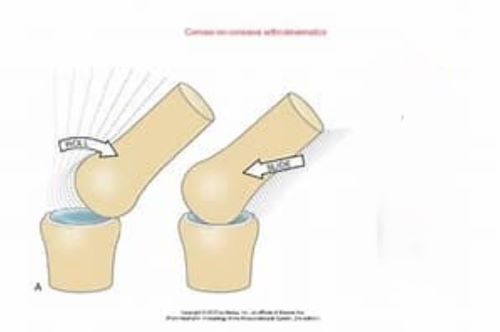
The musculoskeletal system may enable human movement through two main mechanisms: 1) muscle contraction, commonly referred to as input force, which influences articulating bones and is identified as a muscle-driven mechanism (MDM), and 2) a coordinated operation of both muscle contraction and joint torque, denoted as the joint-torque-mechanism (JTM), which is considered output force [2]. MDM is designed to function in conjunction with muscular and skeletal movements, commonly referred to as joint rolls (JR) and slides (JS), performed in a specific manner to generate joint torque.
Graphic image (picture 1) illustrating a joint roll represented by a curved arrow and a joint slide depicted by a straight arrow.
Picture 1
The output force is enhanced more effectively through joint torque in the generation of power, rather than relying solely on the input force produced by muscle contraction. Research suggests that the power advantage can be particularly pronounced, potentially increasing by a factor of up to three (3) during a bicep curl when joint torque is integrated into the movement pattern.
A muscle-driven mechanism emphasizes muscular contraction and necessitates an increase in muscle hypertrophy to lift heavier weights. When movement patterns are executed exclusively by the muscle-driven mechanism, it may result in diminishing returns, muscle imbalances, and performance plateaus.
A one-dimensional strategy focused on building muscle mass, coupled with the failure to engage the joint torque mechanism, may result in dysfunction and injury within the body, contributing to a range of health issues such as muscle fatigue, imbalances, and chronic pain.
Case Study
I carried out a case study involving a 74-year-old male who had limited experience in resistance training. His one-repetition maximum (1RM) for the overhead military press was determined to be 50 lbs. The baseline weight was set at 30 lbs. which represents 86% of the 1RM for the test trial. The subject performed the overhead military press (OMP) for 10 repetitions to failure, employing a muscle-driven mechanism without the inclusion of joint torques in the movement patterns.
Following the training on how to engage the joint-torque mechanism, the subject was able to execute 14 repetitions of the OMP at 40 lbs. demonstrating a 40% improvement in muscular endurance metric relative to the baseline measurement [5].
Layne Norton is a distinguished athlete and bodybuilder. His accomplishments encompass two USA Powerlifting National titles in the 93kg weight class, the title of 2015 Arnold Classic Champion in the same weight category, and an overall silver medal at the 2015 IPF World Championships (93kg).
Norton expressed that when faced with the choice between maintaining strength while enduring pain and succumbing to weakness by retiring from powerlifting to alleviate pain, he opts for strength despite the discomfort. RT 4.0 has the potential to alter this conventional perspective, as it challenges the notion that weightlifting is inherently linked to pain, and RT 4.0 training can elicit beneficial physiological responses.
Clinical Significance
Musculoskeletal disorders encompass a variety of conditions that impact bones, joints, muscles, and connective tissues. In the United States, they affect more than half of individuals aged 18 and older, and nearly three-quarters of those aged 65 and above.
According to the report from the US Bone and Joint Initiative (USBJI) we have made some progress in the prevention and treatment of these issues, however, our comprehensive understanding remains insufficient, and the functional knowledge, which is riddled with gaps, is not being effectively communicated to the public and healthcare providers.
RT 4.0 is designed to incorporate the joint torque into resistance training programs, which is anticipated to significantly contribute to addressing adverse musculoskeletal conditions. It seeks to prevent many of the pain disorders caused by current protocols or, at the very least, to reduce their severity and impact on everyday life.
Implications for Training Interventions
- Resistance Training 4.0 focuses on activating the JMT mechanism, enabling it to generate greater force by utilizing joint torque force rather than relying solely on input force.
- RT 4.0 facilitates positive bodily adaptation and a physiological response that enhances performance while minimizing adverse physiological effects including an impetus to overcome performance ceiling and to avoid training monotony.
- RT 4.0 is designed to meet the demands of the real world and adopts a comprehensive approach to promote overall health by addressing physical endurance, dynamic flexibility, functional movement, and multisport training.
- Resistance training is a primary method used to stimulate muscle hypertrophy and develop strength and stimulate muscle hypertrophy. Systematic review [10] has found that current RT techniques and methods do not provide conclusive evidence and specific guidelines for volume, intensity of effort, and frequency. These findings underscore that integrating the joint torque into training routines may be more effective approach to build muscle mass.
References
- Nuzzo JL. History of Strength Training Research in Man: An Inventory and Quantitative Overview of Studies Published in English Between 1894 and 1979. J Strength Cond Res. 2021 May 1;35(5):1425-1448. doi: 10.1519/JSC.0000000000003959. PMID: 33629976.
- Hamill J, Kathleen Knutzen K, Derrick T. Biomechanical Basis of Human Movement (Lippincott Connect) Fifth, North American Edition, 2021.
- Luttegens k, Hamilton N. Kinesiology: Scientific Basis of Human Motion Ninth Edition, William C Brown Publishing, 1996.
- Norkin CC, Levangie Joint Structure and Function: A Comprehensive Analysis. Sixth Edition, F.A. Davis Company, 2019.
- Marston KJ, Peiffer JJ, Newton MJ, Scott BR. A comparison of traditional and novel metrics to quantify resistance training. Sci Rep. 2017 Jul 17;7(1):5606. doi: 10.1038/s41598-017-05953-2. PMID: 28717150; PMCID: PMC5514046.
- Juneja P, Munjal A, Hubbard JB. Anatomy, Joints. [Updated 2024 Apr 21]. In: StatPearls [Internet]. Treasure Island (FL). Publishing; 2025 Jan. https://www.ncbi.nlm.nih.gov/books/NBK507893/
- Faienza MF, Lassandro G, Chiarito M, Valente F, Ciaccia L, Giordano P. How Physical Activity across the Lifespan Can Reduce the Impact of Bone Ageing: A Literature Review. Int J Environ Res Public Health. 2020 Mar 13;17(6) [PMC free article] [PubMed] [Reference list]
- Lu TW, Chang CF. Biomechanics of human movement and its clinical applications. Kaohsiung J Med Sci. 2012 Feb;28(2 Suppl):S13-25. doi: 10.1016/j.kjms.2011.08.004. Epub 2012 Jan 9. PMID: 22301008; PMCID: PMC11922132.
- National Academies of Sciences, Engineering, and Medicine; Health and Medicine Division; Board on Health Care Services; Committee on Identifying Disabling Medical Conditions Likely to Improve with Treatment. Selected Health Conditions and Likelihood of Improvement with Treatment. Washington (DC): National Academies Press (US); 2020 Apr 21. 5, Musculoskeletal Disorders. Available from: https://www.ncbi.nlm.nih.gov/books/NBK559512/.
- Krzysztofik M, Wilk M, Wojdała G, Gołaś A. Maximizing Muscle Hypertrophy: A Systematic Review of Advanced Resistance Training Techniques and Methods. Int J Environ Res Public Health. 2019 Dec 4;16(24):4897. doi: 10.3390/ijerph16244897. PMID: 31817252; PMCID: PMC6950543.
- U.S. Bone and Joint Initiative (USBOJI) Reports. The impact of Musculoskeletal Diseases in the United States. Overview | BMUS: The Burden of Musculoskeletal Diseases in the United States.